.jpg)
CPR Survival Rates in 2025: What the Latest Data Reveals
Updated: Dec 23, 2025
In 2025, the effectiveness of cardiopulmonary resuscitation (CPR) continues to depend heavily on where cardiac arrest occurs and how quickly CPR is started.
While immediate bystander CPR can double or even triple survival chances, overall survival to hospital discharge remains lower than many people expect—highlighting why CPR training is more critical than ever.
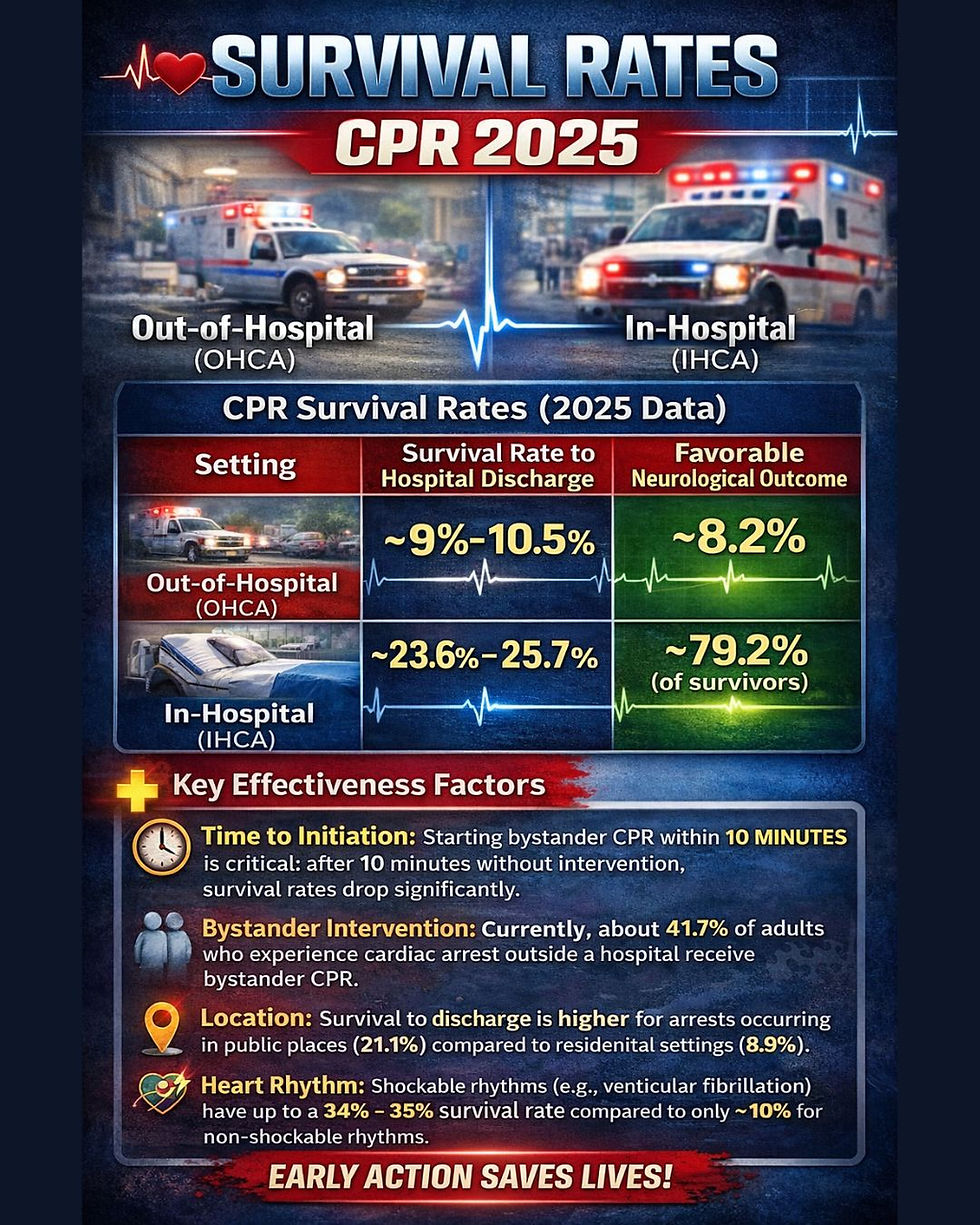
CPR Survival Rates (2025 Data)
Survival to Hospital Discharge & Neurological Outcomes
Out-of-Hospital Cardiac Arrest (OHCA)
Survival Rate: ~9% – 10.5%
Favorable Neurological Outcome: ~8.2%
In-Hospital Cardiac Arrest (IHCA)
Survival Rate: ~23.6% – 25.7%
Favorable Neurological Outcome: ~79.2% (of survivors)
These statistics show that patients who experience cardiac arrest inside a hospital have significantly higher survival and neurological recovery rates compared to those who arrest outside medical settings.
Key Factors That Impact CPR Survival Rates
⏱ Time to CPR Initiation
Starting bystander CPR within the first 10 minutes is critical.
After 10 minutes without CPR, survival rates decline sharply.
For children, beginning CPR within one minute increases survival odds by up to 91%.
👥 Bystander CPR Intervention
Only 41.7% of adults suffering cardiac arrest outside a hospital receive bystander CPR.
Increasing CPR training access could save thousands of lives annually.
📍 Location of Cardiac Arrest
Public locations: ~21.1% survival to discharge
Residential settings: ~8.9% survival to discharge. Public access to CPR and AEDs dramatically improves outcomes.
❤️ Heart Rhythm Type
Shockable rhythms (ventricular fibrillation or ventricular tachycardia):
Survival rates as high as 34%–35%
Non-shockable rhythms:
Survival is closer to 10%. Early CPR and AED use are especially critical for shockable rhythms.
2025 American Heart Association (AHA) CPR Guideline Updates
The 2025 AHA Guidelines for CPR and ECC emphasize early action, simplicity, and quality resuscitation:
🔗 Universal Chain of Survival
Combines adult and pediatric response steps into a single, simplified chain to improve training and response speed.
👶 Early Youth CPR Training
Recommends teaching CPR and AED use to children as young as 12 years old, increasing community readiness.
💊 Opioid Overdose Response
Integrates rapid overdose recognition and response as a standard component of resuscitation efforts.
📏 High-Quality CPR Standards
100–120 compressions per minute
Compression depth: ~2 inches for adults
Compression-to-breath ratio: 30:2
Minimal interruptions to maintain blood flow
Why CPR Training Matters More Than Ever in 2025
CPR saves lives—but only when it’s started immediately and performed correctly.
With survival rates still relatively low, early CPR, AED access, and public training remain the most powerful tools to improve outcomes.
Learn CPR. Be ready. Save a life.